Tomorrow!

It’s hard to know what to think about tomorrow. I’ve been a subscriber to the school of “big factors count most,” so incumbent approval, the economy, right direction-wrong direction, party identification. It probably didn’t matter who the Democrats put up this year. That person was going to win owing to the structural factors. In fact, I turn to racism — or if not overt racism, at least race-related conservatism — on the part of white voters on the Democratic side and selection by the Republicans of the maverick with the maximum crossover appeal among the Republican slate for things being as narrow as they are. However much spleen is being pumped up by the far-right in anticipation of the blood-letting to come after their defeat, Johm McCain was the Republican capable of losing by the least in 2008.

But I’m jumping into the details way too fast. The big picture is that I am making sure that I am getting together with my people tomorrow night early. If we wait too long to meet up, we could miss it. I am anticipating that Senator Obama is not just going to win, but win in a landslide. If he wins Virginia and Pennsylvania, they could call the whole election on that basis. With polls closing in those two states at 7:00, they could have a statistically significant portion of votes counted by 9:00 and it could all be over. This is, of course, barring total electoral chaos.

A dash of confidence off the top, I am still significantly worried and tomorrow evening is going to be a nail-biter all the way until it’s called. I think that polling is essentially sound and the big numbers are the ones that count. The lesson of 2004 seems to be that frittering around the margin is misguided. That being said, I can’t help the frittering. There are still seven percent of voters undecided and presumably anyone still undecided is going to break for Senator McCain. The race is tightening somewhat. And I am completely freaked out over a potential Bradley effect, though it hasn’t appeared in this cycle to date. On the other hand, I am also counting on that segment of people only owning cell phones who don’t show up at all in the polls causing an Obama win larger than expected. And opposite a Bradley effect might be the fact that people want to bet on a winning horse. Maybe the heard mentality will kick in with the undecided votes and they will do what’s cool.

All the rational calculation aside, I am trying to contain an overwhelming amount of positive excitement for tomorrow. I have my rational, pessimistic expectations for an Obama administration. That being said, we will get to witness one of the great bugaboos of U.S. history slain: the idea that only a white man can be entrusted with the fate of the country. I feel like there have been two outstanding political events in my lifetime: the end of the Cold War and September 11th. Tomorrow we will be adding a third event of similar magnitude to the list. President elect Obama should lead the inaugural parade down the Capital Mall instead of Pennsylvania Avenue and take the oath of office not from the Capital, but from the steps of the Lincoln Memorial.

Barack Obama is a phenomenon of his own and deserves the enthusiasm he gets, but part of the determination and anticipation of tomorrow is that after eight seemingly interminable years we will finally be closing the door on a dark period of U.S. history, namely the administration of George W. Bush, Jr.

I find the whole media invented “hundred days” narrative tiresome and I wish that an Obama administration would do something to counter it. But I wholly anticipate a frenetic burst of energy from an Obama administration. There is so much in need of fixing, so much done wrong or neglected, or in need of undoing. And in every instance the right thing so damn plain. There is so much pent up energy at this point. We’re not just going to close the door on the Bush years, we’re going to slam it shut.

The Supernovae in Your Coffee Cup

The Supernovae in Your Coffee Cup

I loved the film π. I consider it a hugely flawed film, but what I loved about it was the way that it worked in subtle allusions to the underlying concepts motivating the film. The main character walked through a park and they point the camera skyward to show the denude winter branches of the trees, an example of fractal symmetry. One of the images that they showed a number of times throughout the film was that of a cup of coffee. Whenever someone ended up in a diner, we got a tight-in shot of them dumping the cream into their coffee and the blooms of turbulent fluid redounding from the depths. It’s a perfect example of turbulence, a phenomenon that utterly defies computation. Since π I’ve never looked at a cup of coffee the same. Every time I pour cream into my coffee it’s a little ritual where for just a second I consider the boundlessness complexity of the world, as close as the cup in my hand.

I was amused to see a recent article in New Scientist invoke the image of the cup of coffee in reference to the problem of turbulent fluids in supernovae (Clark, Stuart, “How to Make Yourself a Star,” vol. 200, no. 2679, 25 October 2008, pp. 38-41):

As the dense inner material is flung through the less dense outer layers of a star, it creates turbulence and mixes everything up. Traditional computer simulations do not model turbulence well.

“Our theoretical understanding of turbulence is incomplete,” says astrophysicist Alexei Khokhlov of the University of Chicago. In other words, you cannot write down a set of equations describing the state of a turbulent system at any given time and then use them to predict what it will look like next. Instead, you have to employ a brute-force approach, using sheer computer muscle.

To seen the scale of this problem, take your morning cup of coffee and stir in some milk. You are using turbulence to mix the two fluids. To determine how they mix, physicists mentally split the cup into boxes and assign numbers to represent the properties inside each box, such as the temperature and density of the fluid. A computer can then calculate how each box interacts with its neighbors during one brief instant of time and then re-evaluate those numbers. Once it has done this for every box, it starts again for the next slice of time and so on.

To do this massive computation perfectly, each box should be tiny and contain just one fluid particle, but before you can get anywhere near this sort of precision, the numbers become mind-bogglingly large. Scientists talk of degrees of freedom as a measure of both the numbers of particles in a system and the number of ways each particle can interact with those around it. A single cup of coffee possesses a staggering 1040 degrees of freedom — far more than you can model on today’s computers. “Maybe in 10 years we will be able to fully model a cup of coffee,” says Khokhlov.

Until then the computation will always be approximate, and thus prone to errors, because small-scale physical interactions are not being taken into account. … If it is going to take 10 years to fully model a cup of coffee, how long until we can model an entire star?

“Never,” Khokhlov says. “Not until someone comes up with a cleaver theory that does not depend on what is happening on the small scale.” The only hope is to continue to investigate turbulence to learn how to better approximate its behavior.

OneMachine Doppelganger

Kevin Kelly has long discussed the OneMachine: the essentially unified, single distributed computer built up from all our networked PCs, PDAs, cell phones, digital cameras and other personal electronics (see e.g. “Tap Into the 12-Million-Teraflop Handheld Megacomputer,” Wired, vol. 16, no. 7, June 2008; “Dimensions of the One Machine,” The Technium, 2 November 2007; “One Huge Computer,” Wired, vol. 6, no. 8, August 1998).

Last week The New York Times ran an article on how below the surface, and running on the very same computers as the productive, life-enhancing OneMachine is a nefarious parallel network, OneMachine’s dark doppelganger, the BotNet (Markoff, John, “A Robot Network Seeks to Enlist Your Computer,” 20 October 2008, p. B1):

Botnets remain an Internet scourge. Active zombie networks created by a growing criminal underground peaked last month at more than half a million computers, according to shadowserver.org, an organization that tracks botnets. Even though security experts have diminished the botnets to about 300,000 computers, that is still twice the number detected a year ago.

The actual numbers may be far larger; Microsoft investigators, who say they are tracking about 1,000 botnets at any given time, say the largest network still controls several million PCs.

“The mean time to infection is less than five minutes,” said Richie Lai, who is part of Microsoft’s Internet Safety Enforcement Team, a group of about 20 researchers and investigators. The team is tackling a menace that in the last five years has grown from a computer hacker pastime to a dark business that is threatening the commercial viability of the Internet.

I have already written about how when the singularity occurs, it may not be what we expect. My suspicion is that either it will be overtly evil, or merely a recreation of the chaos of biological nature in a more durable, powerful and virulent form (“A Few Heretical Thoughts on the Singularity,” 19 August 2008).

What do phenomena like the BotNet suggest about the singularity? What comes will grow out of what is and what is will bequeath its characteristics to what comes — at least initially. Between the various military establishments and the criminal underground, we are instilling our machines with hostile, aggressive tendencies. But we are also making numerous, competitive systems. Will there be “the singularity” or will it, like in the novels of Vernor Vinge and Charles Stross, come in secretive, uncertain fits and starts? Will there be multiple singularities? Will one system cross the threshold, followed by another, then another. It makes sense to speak of “the singularity” when one is imagining a unified system, but when one is considering a multitude of contending systems, crossing the threshold of the singularity is but one move in a strategic game. Perhaps the machines will be hostile to predecessor biological life, but perhaps they will be so consumed in competition with their fellow AIs as to be merely indifferent to us, as we are to, say, pigeons or squirrels.

And how goes the strategic competition between OneMachine and BotNet? We ought to know. What portion of computational capacity, bandwidth, energy consumption, hours of their masters’ time are the two consuming? Qualitatively, how are they matching capabilities? Kevin Kelly has managed to make some calculations for the former, but what of the latter? Of course this would subject to the usual problems of surveillance of those who do not want to be surveyed.

Organizations like McAffee, Norton and the International Botnet Taskforce are attempting to build something akin to an immune system for the Internet, but the billion-year persistence of the arms race between host immune systems and the various infectious agents suggests that dampening catastrophe is probably the best outcome we can hope for. It’s an example of co-evolution where competition between host and agent drives the development of one another. Viruses don’t kill their host by design, they merely seek to hijack their reproductive machinery to their own purposes. Killing the host, or at least killing them too quickly, or the epiphenomenon of killing too many of them too quickly, are all suboptimum in that they result in diminished opportunity for continued infection and reproduction. Ebola gets it wrong. HIV gets it really right. But virus behavior as a whole is not intelligent. Occasionally a virus goes super virulent or hits a particularly vulnerable population and massive outbreak occurs that wrecks havoc for host and infectious agent alike. I presume that BotNets will continue to act something like this.

And since one third of known biological species are parasites and the proportion seems to be growing, it would seem that there is something fundamental about the strategy of parasitism. We should anticipate its continuance, both in genetic and electronic space.

Delivery

I think that this last debate was actually acceptable. There was a lot more contention and contrast. I mean, they’re both horrible bores. If I hear one more “independent voter” say that they’re not going to make up their mind until the candidates level with them about details I’m going to scream. I’m a wonkish type and I at a number of points Senator Obama was so thick in the numbers and turns of one policy or another that I was glazing over.

It was amazing the degree to which John McCain has failed to absorb the lesson of the Bush-Gore debate of 2000: being a sore debater doesn’t score any points. He’s like the snorting minotaur, lost in the labyrinth. Smoldering and scoffing isn’t winning over any undecided Athenians.

Maybe it was all just my mood, but for once I loved the punditocracy in all of their sprawling, self-referential drama, entirely divorced from the fate of the nation. It’s the most preposterous, grandiloquent reality show on television. David Gergan is our frog prince statesman. Jeffry Tobin is the ringmaster, comical and macabre, the Harold Zidler of CNN’s Moulin Rouge. Anderson Cooper was flashing blue steel, letting Wolf Blitzer know that this was AC360, not the Situation Room. Carl Bernstein and Candy Crowley, conspicuous in their absence, must have snuck off to make out under the bleachers. I love Andrea Mitchell but in these troubles times she doth protest too much for her beleaguered husband. I’ve always thought that there was something about the Monica Lewinski / Chandra Levy archetype, but to see Maria Bartiromo, cigar-chomper of CNBC, MILF statistician Cambel Brown and Soledad O’Brien, the Marisa Tomei of television journalism, one after another was an undeniable demonstration of the place of prominence of the Brooklyn-Jersey-Long Island brunet in the D.C. psychodrama of blow-dried grey-haired power-mongers.

The most characteristic thing anyone has ever said of D.C. was when Kissinger said in his realpolitik German accent that “Power is the ultimate aphrodisiac.” The D.C. media establishment is Pepe Le Pew floating in misdirected amore along the scent trail of a painted cat. The contrast between the dithering fuddy-duddies of the Senate and the fiddling Neros of burning Rome was beautiful. It was a pyroclastic flow of superheated bullshit. The planetary nebula of the waning days of the new Rome. Like the skeleton at the feast, I can’t help myself.

Update, 16 October 2008: Wow. In the person of Jessi Klein, frog prince David Gergen has found his princess (“I’m in Love With David Gergen,” The Daily Beast, 15 October 2008):

I love his low, quiet voice. That unmodulated buttery whisper that sounds like it’s elbowing its way past a cough drop that’s permanently lodged at the back of his throat. You know how Bed Bath & Beyond sells those white noise machines that help you sleep? And they usually make ocean noises? I want one that’s just David Gergen gently muttering about the economy.

I love the way Gergen makes me feel calm, even when he’s making dire predictions about the future of our country. I love the way he knows everything and then formulates an opinion about everything that’s always right. I love that his eyebrows only move when he gets mad, and I love that he almost never gets mad. I love that he looks like a handsome baked potato.

I love David Gergen too. He’s the sort of old school commentator — polite, level headed, calm — that has been replaced over the years by interrupting, screaming, unhinged children of commentators. David Gergen is like watching old reels of Meet the Press from 1961.

The Antiquated Public Paradigm of Economics

Robert Waldmann at Angry Bear goes on a considerable rant about the way that the state of contemporary economics is represented (“What’s Wrong with Economic Theory as Presented to the Public?,” 3 October 2008). It turns out that everything you may have learned in Econ 101 and 102 was representative of the state of the science circa 1950 and that things have become much more complicated since then.

The conclusions of economic theory as presented by many or perhaps most economists do not follow from current economic theory, but rather from the 50 year old efforts at mathematical economic theory.

… the worse problem is that economists who are also libertarian ideologues are lying about the current state of economic theory, not only its very weak scientific standing, but the fact that, even if it were all absolutely true, their policy recommendations do not at all follow from current economic theory.

You mean to tell me that those hoary old supply-demand curves, the very paradigm of economic thought, have been replaced by game-theoretic concepts like Nash equilibrium?

Part of me reads this and thinks “Great! We’re free. We are no longer bound in our policy aspirations by the dictates of the dismal science!,” but then I think that economic policy is way too important for us to just do what we will, without any ability to anticipate probable outcomes or any concern therefor. Surely some portion of what goes on in at least some sectors of economics is on solid ground, right? They sure act like it is at the Federal Reserve or the Congressional Budget Office or the Office of the Chief Actuary of the Social Security Administration.

It would be nice to know Mr. Waldmann’s assessment of the various areas of economics. It would seem that the general equilibrium theory of the microeconomy, any simple notion of market clearing and the possibility of straightforward optimization are all out. Perhaps the macroeconomy is easier? Perhaps social scientific descriptions work better over aggregate social phenomenon? Or perhaps the Federal Reserve Chairman is L. Frank Baum’s proverbial Wizard of Oz, just eyeballing it, but dazzling us munchkins with his light and numbers show?

Deliver Me From These Awful Debates

I’m the kind of person who gets wound up over the State of the Union Address like it were the Super Bowl, but both these debates bored the life out of me. I was looking at the clock and whishing for it to be over. I blame it on the Senate: it’s too insular a world. When Senator McCain said that he had written a letter to the Treasury Secretary that Senator Obama had not signed, that he whishes we could see that letter, I was one impressed customer. You wrote a letter. I’ll bet the Treasury Secretary wound up the entire department and wrote one back. God! If the next president would just write a letter to Wall Street or to Mahmoud Ahmadinejad, I’ll bet they would write letters back too.

And John McCain’s jokes were such insufferable stinkers. His stilted humor is the perfect analog to his person. And what was up with that bizarre attack on Tom Brokaw?

And where is the Barack Obama of the prepared statements? Take away rehearsal and he’s just another quibbling, rambling Senator lost in the shuffle. In the last debate when he stammered for what seemed like two or three minutes trying to get out the name of that thing we did with those other countries about those big bombs I couldn’t believe it. “The Nuclear … uh … uh … Proliferation … uh … Agreement.” It’s a treaty. What’s so hard about that?

Tom Brokaw was a dud of a moderator. Where the hell did he dig up that completely arbitrary non sequitur about holding Congress to a two year deadline to reform Social Security? Why not the proverbial first hundred days?

People who say that one candidate or the other won are either spin-meisters or possessed of higher levels of discernment than me. I think that these debates are completely inconsequential for the outcome a month from now.

The Perspective of the World, 2008

The recent, dramatic drops in the Dow Jones Industrial Average command attention, but they are foam. The real currents of the current crisis are mostly hidden from public view. Some journalists are burning a lot of shoe leather to bring that story to light, but I imagine that much of it will remain obscured from history to all but the actors themselves.

And so Fernand Braudel in Civilization and Capitalism, 15th-18th Century, Volume I: The Structures of Everyday Life: The Limits of the Possible (trans. Siân Reynolds, New York: Harper & Row Publishers, 1981):

On the other hand, looking up instead of down from the vast plane of the market economy, one finds that active social hierarchies were constructed on top of it: they could manipulate exchange to their advantage and disturb the established order. In their desire to do so — which was not always consciously expressed — they created anomalies, ‘zones of turbulence’ and conducted their affairs in a very individual way. At this exalted level, a few wealthy merchants in eighteenth-century Amsterdam or sixteenth-century Genoa could throw whole sectors of the European or even world economy into confusion, from a distance. Certain groups of privileged actors were engaged in circuits and calculations that ordinary people knew nothing of. Foreign exchange for example, which was tied to distant trade movements and to the complicated arrangements for credit, was a sophisticated art, open only to a few initiates at most. To me, this second shadowy zone, hovering above the sunlit world of the market economy and constituting its upper limit so to speak, represents the favored domain of capitalism, as we shall see. Without this zone, capitalism is unthinkable: this is where it takes up residence and prospers. (p. 24)

The New York Times last Thursday (Nocera, Joe, et. al., “As Credit Crisis Spiraled, Alarm Led to Action,” 2 October 2008, p. A1):

This is what a credit crisis looks like. It’s not like a stock market crisis, where the scary plunge of stocks is obvious to all. The credit crisis has played out in places most people can’t see. It’s banks refusing to lend to other banks — even though that is one of the most essential functions of the banking system. It’s a loss of confidence in seemingly healthy institutions like Morgan Stanley and Goldman — both of which reported profits even as the pressure was mounting. It is panicked hedge funds pulling out cash. It is frightened investors protecting themselves by buying credit-default swaps — a financial insurance policy against potential bankruptcy — at prices 30 times what they normally would pay.

It was this 36-hour period two weeks ago — from the morning of Wednesday, Sept. 17, to the afternoon of Thursday, Sept. 18 — that spooked policy makers by opening fissures in the worldwide financial system.

Anomalies, zones of turbulence, fissures: call them what you will.

The First Sovereign to Fall?

It would appear that Iceland will be the first sovereign imperiled by this spreading financial crisis (McVeigh, Tracy, “The Party’s Over for Iceland, the Island that Tried to Buy the World, The Observer, 5 October 2008):

Iceland is on the brink of collapse. Inflation and interest rates are raging upwards. The krona, Iceland’s currency, is in freefall and is rated just above those of Zimbabwe and Turkmenistan. One of the country’s three independent banks has been nationalised, another is asking customers for money, and the discredited government and officials from the central bank have been huddled behind closed doors for three days with still no sign of a plan. International banks won’t send any more money and supplies of foreign currency are running out.

People talk about whether a new emergency unity government is needed and if the EU would fast-track the country to membership. On Friday the queues at the banks were huge, as people moved savings into the most secure accounts. Yesterday people were buying up supplies of olive oil and pasta after a supermarket spokesman announced on Friday night that they had no means of paying the foreign currency advances needed to import more foodstuffs.

Iceland is outside the Euro zone so they are facing a currency crisis as well. Take a look at ECB exchange rate data. The Icelandic krona has fallen 181 percent against the euro, from €86.25 one year ago to €156.13 on Friday.

I wonder if there’s any substance to the idea of fast-track E.U. membership. Just like this crisis has precipitated a wave of bank consolidation, maybe it will allow the E.U. to snap up a few holdouts as well. I notice that that hole in the E.U., Switzerland, is also overrepresented as the homecountry to a number of troubled banks.

Update, 6 October 2008: Iceland had to bailout its third largest bank, Glitnir. The problem is that Iceland’s top three banks have assets nine times the GDP of Iceland (Magnusson, Niklas and Helga Kristin Einarsdottir, “Iceland Savers Fear ‘House of Cards’ May Collapse After Glitnir,” Bloomberg, 3 October 2008). One of Portfolio.com’s bloggers points out the obvious (Salmon, Felix, “Iceland: When Too Big To Fail Becomes Too Big To Rescue,” 3 October 2008):

Received opinion has it that if Iceland backstops the Icelandic banks, then the other Nordic countries, or someone, will backstop Iceland.

This was my point in emphasizing the idea of fast-track E.U. membership, E.U. membership being more dignified than IMF intervention.

A Co-President?

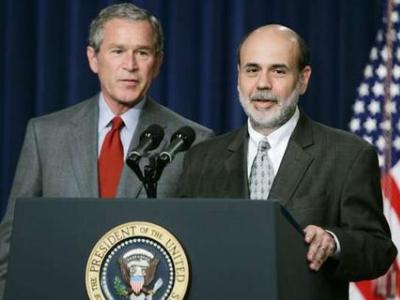
Federal Reserve Chairman Ben Bernanke and President George W. Bush

At the constitutional convention in summer of 1789 the founding fathers struggled to find an amenable compromise between those desiring a vigorous executive and those concerned about despotic overreach. One proposal to limit the executive was that instead of concentrating power in a single person, create a miniature division of powers by having a triumvirate of co-presidents.

Events of the past few weeks have been instructive. It would appear that the Federal Reserve Act of 1913 delivered us a co-presidency in a sub-constitutional manner. It would appear that they each have their own portfolio: one is commander and diplomat in chief and the other is the captain of the macro-economy. With his 20 year term, substantial independence, control over interest rates, lending capability, 800 billion in capital and a regulatory mandate over the banking system, the Federal Reserve Chairman has a vast array of powers, while not on par with the official executive, impressive nonetheless.

It’s also worth noting that, like the official President, the Federal Reserve Chairman accrues perhaps the better part of his powers through reputation, as a focal point of attention and the judicious use of his own particular bully pulpit.

This has some potentially troubling implications, depending on where you fall on the democratic spectrum. In this regard, Will Wilkinson has some interesting ruminations on what he calls “the structure of the de facto American constitution” (“What’s an Incrementalist Market Liberal to Think?,” 19 September 2008; the previous post, “The Benign Rule of Ben Bernanke and the Ideal of Democratic Equality, 18 September 2008, along the same lines is also good too).

It’s also worth noting — something that has become apparent throughout the Bush years — that many of the constraints on the presidency are not official, but adhered to only out of tradition. When the situation warrants — or ambition allows — the executive is capable of blowing through its traditional restraint, erupting into a ferocious activism. When this happens in the realm of foreign policy everyone loves it. Nothing gets people excited like a little kicking of foreigner ass. When it happens in the domestic or economic realm, people aren’t so enthusiastic, as Congressional telephone lines, recently clogged with populist anti-high finance carping, will attest.

The Future of Economics: The Arational and the Irrational

Back in 2000 The Economist ran an article titled “The Future of Economics” (4 March 2000, p. 80). It was largely a gloss on a symposium on the same from the Journal of Economic Perspectives (vol. 14, no. 1, Winter 2000). The authors acknowledged that economics was a faltering field. Setting aside the proposition that economics may simply have run it’s course and be into its dotage of diminishing returns, the article considers two possibilities for a way forward:

David Colander of Middlebury College, in an article that looks back on the present from an imagined 2050, blames the current discontent on the orthodox general-equilibrium model that underlies most of today’s economic theory. He favors a shift from the current approach, which has been called “loose-fitting positivism” (propose a model consistent with standard assumptions, then test it), to one based on “loose-fitting pragmatism” (forget about canonical principles, just search for patterns in the data).

Such an approach, he says, would be consistent with “the rise of complexity science within the scientific community generally.” Researchers sitting at their computers, subjecting data to a withering barrage of statistical analysis, would still hope to come up with laws of a sort, or regularities at any rate. But these “laws” would be regarded as provisional and ever-shifting: indeed, the claim is that changeless underlying patterns do not exist. Complex systems expand and evolve; even at the most fundamental level, these patterns are temporary. But whether this approach could still be called “economics” is debatable.

The second approach is much easier to reconcile with traditional methods. Its most celebrated exponent is Richard Thaler of the University of Chicago, who has also written a paper for the symposium. Mr. Thaler agrees that the canonical principles of orthodox theory have led economics astray, but he believes these mistakes can be put right. He seeks, in other words, a tighter-fitting positivism. You improve the fit above all, he would argue, by putting a more realistic account of human cognition at the center of the theory.

Orthodox theory famously assumes that people are rational. In reality, they are not. On the other hand, they are not crazy, or crassly incompetent — in other words, their behavior is not random. If economics could try harder to recognize that people try to be rational, but in certain, often predictable, ways fail to be, the positivist approach would have a better foundation. In essence, what Mr. Thaler calls for is a marriage, or at least much closer cohabitation, between economics and psychology.

I have thought of this article frequently since reading it back in 2000 when it was first published. Given the spate of books along these lines, especially the second, I’d have to say that this was one of the more perspicacious articles that I’ve ever read.

The first approach is an example of Petabyte Age type thinking, eight years before Wired put it on the cover. But of course it is an idea that had to incubate in the rarified world of advanced theoreticians for years before any eruption into the popular conscience. The main offering in this area would be Steven Levitt and Stephen Dubner’s Freakonomics (2005), though their book is not a fully atheoretic inquiry so much as putting of large questions to the test of large data sets. More to the topic would be Ian Ayres’s Super Crunchers: Why Thinking-by-Numbers Is the New Way to Be Smart (2007), though the fact that Mr. Ayres used the very methods he describes in his book to arrive upon a title casts a great deal of doubt on the soundness of said methods.

As for the build a better model of the economic corpuscles approach, it seems to have advanced along far enough that it is now also ready to be packaged up for mass consumption. And of course the psychologists have much more lucrative options in publishing than the mathematicians and computer scientists.

Judging by some of the key phrases in the Economist article (the predictably irrational stuff) I was pretty sure that they had in mind Dan Ariely’s thinking, published as Predictably Irrational (2008), but it turns out that Richard Thaler is, along with Cass Sunstein, the author of Nudge (2008). Rounding out the most omnipresent trio is Tim Harford’s The Logic of Life: The Rational Economics of an Irrational World (2008). Also on the list of offerings along this line would be Ori and Rom Brafman’s Sway: The Irresistible Pull of Irrational Behavior (2008) and Michael Shermer’s The Mind of the Market: Compassionate Apes, Competitive Humans, and Other Tales from Evolutionary Economics (2007).

So that’s the future of economic study. Either a discounting of human rationality in favor of the system effect of irrationality or allowing rationality to drop out in favor of the system effect of economic thing-in-itself.